

Skip to content
(480) 999-0905
FacebookLinkedin
Arizona's Only Accredited Master Surgeon - Greg J. Marchand M.D.Arizona's Only Accredited Master Surgeon - Greg J. Marchand M.D.
Arizona's Only Accredited Master Surgeon – Greg J. Marchand M.D.
  • Dr. Greg Marchand
    • About Dr. Marchand
    • Funding & Independence
  • Fellowship
  • Research
    • Publications
    • Research Methodology
    • Clinical Trials
    • Research Team
  • Newsroom
    • Press Kit
    • Expert Commentary
    • Media Coverage
    • Video Appearances
  • Collaborate
  • Contact
  • Dr. Greg Marchand
    • About Dr. Marchand
    • Funding & Independence
  • Fellowship
  • Research
    • Publications
    • Research Methodology
    • Clinical Trials
    • Research Team
  • Newsroom
    • Press Kit
    • Expert Commentary
    • Media Coverage
    • Video Appearances
  • Collaborate
  • Contact

The Gray Journal: Our Cerclage Meta-Analysis Is Now Online in the American Journal of Obstetrics and Gynecology

November 1, 2026Laparoscopy, Minimally Invasive Surgery, OBGYNBy Maria Sainz

Every obstetrician in America knows the Gray Journal. The American Journal of Obstetrics & Gynecology has been published continuously since 1920, it is the journal our specialty reads first, and as of today it carries the biggest paper of my career.

Surgical and Obstetric Complications of Transabdominal Cervical Cerclage by Laparoscopic, Open, and Robotic Approaches: A Systematic Review and Meta-Analysis

Marchand GJ, Gonzalez Herrera D, Robinson M, O’Connell B, Anderson D, Mera S, Palma A, Ibrahim F, Azadi A. Am J Obstet Gynecol. Article in Press, online November 1, 2026. DOI 10.1016/j.ajog.2026.10.040.

Where to read it

The article on ajog.org (Articles in Press) · DOI 10.1016/j.ajog.2026.10.040. PubMed: PMID 42967520. PROSPERO registration CRD420261422920.

Why this operation matters to me

A transabdominal cerclage is a stitch placed at the very top of the cervix, from inside the abdomen, for women whose cervix cannot stay closed through a pregnancy and for whom the usual vaginal stitch has failed or is not possible. For most of its history that meant open surgery. In 2010 Dr. Richard Demir and I presented a laparoscopic cervical cerclage performed in an 18-week pregnant uterus at the Society of Laparoendoscopic Surgeons and at the British International Congress in Belfast, and we published the technique as a training video. Dr. Demir is gone now, and I think about him every time I place one of these. In 2023 Rutgers New Jersey Medical School put that technique into its OB/GYN core competencies curriculum, which remains the proudest teaching moment I have had.

So I have a stake in this operation, and that is exactly why this paper had to be done the hard way.

Explainer: what is a laparoscopic cerclage? Cervical insufficiency, the stitch that holds the cervix closed, keyhole placement, and where the technique came from.

What was wrong with the old evidence

My team has published two previous meta-analyses on abdominal cerclage, one on complications in JMIG in 2021 and one on efficacy in EJOG in 2022. Both of them, like every other review in the field, compared the laparoscopic literature with the open literature as two separate piles and drew conclusions from the difference between the piles. The problem is that the two piles were never the same patients, the same era, the same surgeons or the same definitions. This time we asked a narrower and much more honest question: when a single study reported both routes in the same population, did one route actually do better? It did not. The separately pooled method cannot establish an advantage for either route, and the within-study evidence does not show one.

What we did

We searched PubMed, Cochrane CENTRAL, Web of Science and Embase through June 12, 2026, carried forward every eligible study from our previous review, and screened citation lists. Screening was duplicate and blinded. Every complication count was taken from the source full text against a written schema, not from a table in someone else’s review. Risk of bias used instruments matched to the design of each study, and we graded certainty separately for the comparative question and the absolute question. The search returned 822 database records, 440 once duplicates were removed. We included 67 reports, withdrew four that overlapped, and analyzed 63 studies, 70 study arms and 5,094 unique women. That makes it the largest body of patients ever assembled on this operation, and the first analysis restricted to within-study comparisons. The comparison itself rests on six studies and 317 pregnancies, every one of them non-randomized and at serious risk of bias.

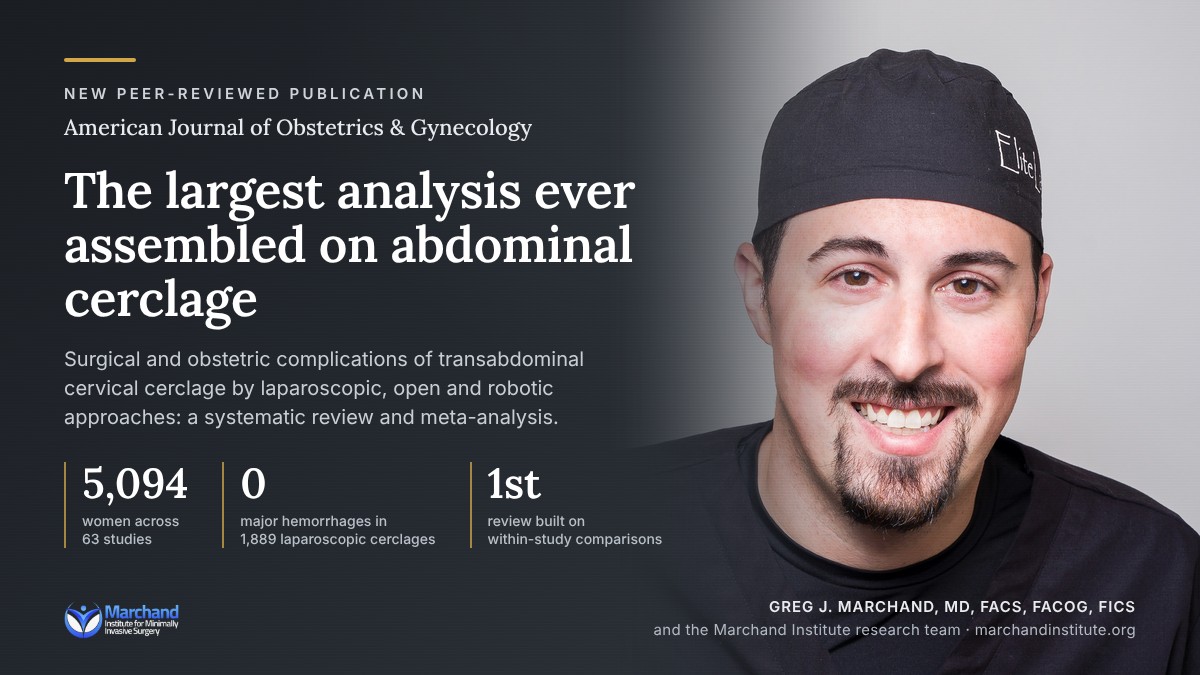
Transabdominal cerclage by the numbers: 5,094 women, 63 studies, six within-study comparisons, zero major hemorrhages in 1,889 laparoscopic procedures.

What we found

  • Six studies, 317 pregnancies, compared the routes internally. Across them there was no detectable difference in any complication. Total fetal loss gave a risk ratio of 0.83 (95% CI 0.19 to 3.64) for laparoscopic versus open, and second-trimester loss 0.97 (0.21 to 4.46). Those intervals are wide enough to hide a real difference in either direction, so this is not a finding of equivalence. It is a finding that the question is unresolved, and the certainty of every comparative estimate is very low.
  • Major hemorrhage and uterine perforation were uncommon after laparoscopic placement. Not one major hemorrhage was reported in 1,889 laparoscopic procedures, which caps that risk at 0.2 percent. The open literature that reported it pooled at about 2 percent, or 5.3 percent with the conventional continuity correction, but that is a comparison of two literatures, not of two routes, and we do not make it. Inside the studies that compared the routes directly, hemorrhage and perforation had no events in either arm.
  • Pregnancy loss is not uncommon. In the single-route series, total fetal loss ran about 7.5 percent after laparoscopic placement and about 8.9 percent after open placement, with overlapping intervals, and a conventional continuity-corrected model pushed every estimate higher, seven-fold for perforation. We report both models so nobody has to take our word for which one flatters the result.
  • The advantages reported in earlier reviews do not reproduce inside cohorts. Four of the six comparative studies were already sitting inside the largest previous synthesis, 83 studies and 3,398 women, which reported that no study compared the routes directly. The comparison was never absent. It was dissolved, because a study reporting both routes enters a separately pooled analysis as two single arms.

What it means

If you are a woman facing this operation: in nearly two thousand reported laparoscopic procedures there was not one major hemorrhage, and perforation was uncommon too. The thing to worry about is not the operation. It is the pregnancy. Roughly one in twelve was still lost after an abdominal cerclage by either route, and no route has been shown to change those odds. If you are a surgeon: pick the route you do best, for the anatomy in front of you, at the point in pregnancy you are in, weighed with the efficacy evidence and what your patient wants. Do not pick it because a review compared two separate literatures and found a difference.

If you are a researcher: the field does not need another single-arm series. It needs reports from centers performing both operations, with arm-level numerators and denominators for each complication and the threshold, the perforation definition and the timing stated. Only one of the six comparative studies reports PPROM by arm and only three report perforation by arm, and the existing cohorts almost certainly contain those numbers. Until someone publishes them we will keep writing this review.

Quote from Greg J. Marchand, MD: Choose the route your surgeon does best, in the anatomy in front of you, at the point in pregnancy you are in, weighed with the efficacy evidence and what the patient wants. That should decide, not a comparison of two separate pools of literature.

Five rounds of review

This paper went through five rounds of revision at AJOG, and the editors pushed us on exactly the things that should be pushed on: which statistical model is primary when events are rare, how to appraise single-arm cohorts honestly, and how far a sensitivity analysis can be read. It is a much better paper for it, and I am grateful to them.

Congratulations and thanks to Daniela Gonzalez Herrera, McKenna Robinson, Brooklynn O’Connell, Dakota Anderson, Sarah Mera and Adriana Palma at the Institute, to Fatima Ibrahim at Fayoum University, and to Dr. Ali Azadi, who has been beside me on the cerclage papers since the first one. We took no funding for this work and have no conflicts to declare.

Greg J. Marchand, MD, FACS, FACOG, FICS

Share this:

  • Share on X (Opens in new window) X
  • Share on Facebook (Opens in new window) Facebook

Like this:

Like Loading…

Related

Related posts
New in EJOG: Surgical Management of Interstitial (Cornual) Pregnancy
October 10, 2026
American Journal of Obstetrics & Gynecology MFM (AJOG MFM) journal cover
Fresh Off the Press in AJOG MFM: Marchand Institute’s New Meta-Analysis on Single- vs. Double-Layer Uterine Closure and Cesarean Scar Outcomes
July 28, 2026
New Research from Dr. Greg Marchand: Evaluating the Impact of Robotic Assistance in Single-Site Hysterectomy
February 20, 2026
Exciting News: Dr. Marchand’s Latest Meta-Analysis on Opportunistic Salpingectomy for Epithelial Ovarian Cancer Prevention is Published and Open Access!
February 5, 2026
New Systematic Review and Meta-Analysis: Comparative Risk of Neonatal Ischemic Encephalopathy in Operative Vaginal Delivery vs. Cesarean at Complete Dilation – Now Online in AJP!
January 29, 2026
We're thrilled to announce the publication of a groundbreaking systematic review and meta-analysis led by Dr. Greg Marchand and the dedicated research team at the Marchand Institute for Minimally Invasive Surgery! Titled "Laparoendoscopic Single-Site Surgery Versus Conventional Laparoscopic Surgery in Ovarian Cystectomy: A Meta-Analysis", this comprehensive study compares two advanced minimally invasive techniques for removing benign ovarian cysts — Laparoendoscopic Single-Site Surgery (LESS) (using a single small incision, often hidden at the umbilicus for superior cosmetic results) and Conventional Laparoscopic Surgery (CLS) (using multiple small incisions). Analyzing data from 9 studies involving 1,368 women, the meta-analysis reveals compelling insights: LESS is associated with longer operative times (by about 9.4 minutes on average), likely due to the technical demands of working through a single port. However, patients undergoing LESS benefit from a shorter hospital stay (reduced by approximately 0.26 days). Importantly, there are no significant differences in key safety outcomes: postoperative pain scores (at 6 and 24 hours), estimated blood loss, need for opioid analgesics, drop in hemoglobin levels, or overall complication rates. These findings strengthen the evidence that LESS is a safe, effective, and viable alternative to conventional laparoscopy for women with benign ovarian cysts — offering faster recovery and excellent cosmetic advantages while maintaining comparable safety and pain profiles. This work adds valuable high-level evidence to the field of minimally invasive gynecologic surgery and reflects the Marchand Institute's ongoing commitment to advancing women's health through rigorous, volunteer-driven research. Read the full open-access paper for free today: PubMed Central (PMC) (recommended - full text & PDF): https://pmc.ncbi.nlm.nih.gov/articles/PMC12734174/ Direct PDF download: https://pmc.ncbi.nlm.nih.gov/articles/PMC12734174/pdf/jcm-14-08739.pdf Published in Journal of Clinical Medicine (December 10, 2025) – DOI: 10.3390/jcm14248739 We invite clinicians, researchers, and patients interested in the latest advancements in minimally invasive surgery to explore this important contribution. A huge thank you to our incredible team of researchers, students, and collaborators who made this possible — all volunteer efforts dedicated to improving outcomes for women everywhere! Visit us at marchandinstitute.org to learn more about our ongoing research, educational programs, and mission to push the boundaries of minimally invasive techniques.
Newest Paper on Laparoscopic Single Site Ovarian Cystectomy Online Now!
January 1, 2026
Articles
  • The Gray Journal: Our Cerclage Meta-Analysis Is Now Online in the American Journal of Obstetrics and Gynecology
    November 1, 2026
  • New in EJOG: Surgical Management of Interstitial (Cornual) Pregnancy
    October 10, 2026
  • American Journal of Obstetrics & Gynecology MFM (AJOG MFM) journal cover
    Fresh Off the Press in AJOG MFM: Marchand Institute’s New Meta-Analysis on Single- vs. Double-Layer Uterine Closure and Cesarean Scar Outcomes
    July 28, 2026
  • New Research from Dr. Greg Marchand: Evaluating the Impact of Robotic Assistance in Single-Site Hysterectomy
    February 20, 2026
  • Exciting News: Dr. Marchand’s Latest Meta-Analysis on Opportunistic Salpingectomy for Epithelial Ovarian Cancer Prevention is Published and Open Access!
    February 5, 2026
  • New Systematic Review and Meta-Analysis: Comparative Risk of Neonatal Ischemic Encephalopathy in Operative Vaginal Delivery vs. Cesarean at Complete Dilation – Now Online in AJP!
    January 29, 2026
What patients say
  • 14517468_1646198135690553_6990924301147850409_n“I delivered both my beautiful babies with Dr. Marchand and I wouldn’t have it any other way! Every doctor visit up until I was in labor was great, he took all the time to answer all my questions. I didn’t feel rushed in and rushed out of the office. The office was always very clean! The staff were always very friendly. When I was in labor he made sure my birth plan was the most important thing! He always had my best interest in hand! My first delivery I was induced and it took 3 long days and Marchand kept checking on me all hours of the night!! If I did it all over again I’d definitely use Marchand as my OB again!”

    Related

    Alex S.
  • “We congratulate Dr. Greg J. Marchand as SRC’s first Surgeon of Excellence in Minimally Invasive Surgery (SOEMIS) in the United States. To achieve SOEMIS accreditation, Dr. Marchand invited SRC to complete a rigorous onsite inspection and thorough chart review to illustrate his compliance with the program. Dr. Marchand and his practice exemplify SRC’s commitment to patient safety and care.”

    Related

    Ashley DuBray, Senior Director of the Surgical Review Corporation
  • “I initially met Dr. Marchand upon an emergency room visit due to complications during my first pregnancy. My husband and I had recently moved from out of state. Not knowing many people here, in a scary situation and finding myself hospitalized was made a lot easier once we met Dr. Marchand who we decided would be the best doctor to see my care through the pregnancy and ultimate c-section. He always had time for our questions even when we knew he had many other patients. He did a great job with the surgery and follow up care and was very pleasant, patient and professional throughout the process. When we decided to have another baby, he saw us through another pregnancy and c-section and continues to be my OB of choice. I would recommend him in a heartbeat to any girlfriends I know.”

    Related

    Megan E. of Gilbert, AZ
  • “Growing up I have had my fair share of woman health issue from Endometriosis, PCOS, Severe Pelvic Pain, Loss of Pregnancy and Infertility and more pelvic surgeries than I can count. I have seen many different doctors till about 6-7 years ago when I needed emergency surgery and met Dr. Marchand and now I refuse to go to any one else. With the many issues I have had both Dr. Marchand as well as his whole office staff have been so helpful I couldn’t be more grateful. It’s very hard to find an honest, trustworthy doctor these days but rest assured you can’t go wrong with Dr. Greg Marchand. They are open late and almost always can fit you into the schedule for emergencies and you can always reach him no matter what time it is if you have questions. Dr. Marchand is an amazing surgeon and loves what he does. He has delivered many friends and family’s children and hope that one day he will be able to deliver mine as well.”

    Related

    Tomi M. of Gilbert
Arizona's Only Accredited Master Surgeon - Greg J. Marchand M.D.
© Greg Marchand MD

Loading Comments...
%d

    Research repository

    Every paper, abstract and presentation Dr. Marchand publishes is listed in his open research repository. Subscribe by RSS to be notified whenever new work is added.

    Browse the repository All research (RSS)

    Topic feeds: Peer-reviewed articles | Conference presentations