

Fresh Off the Press in AJOG MFM: Marchand Institute’s New Meta-Analysis on Single- vs. Double-Layer Uterine Closure and Cesarean Scar Outcomes
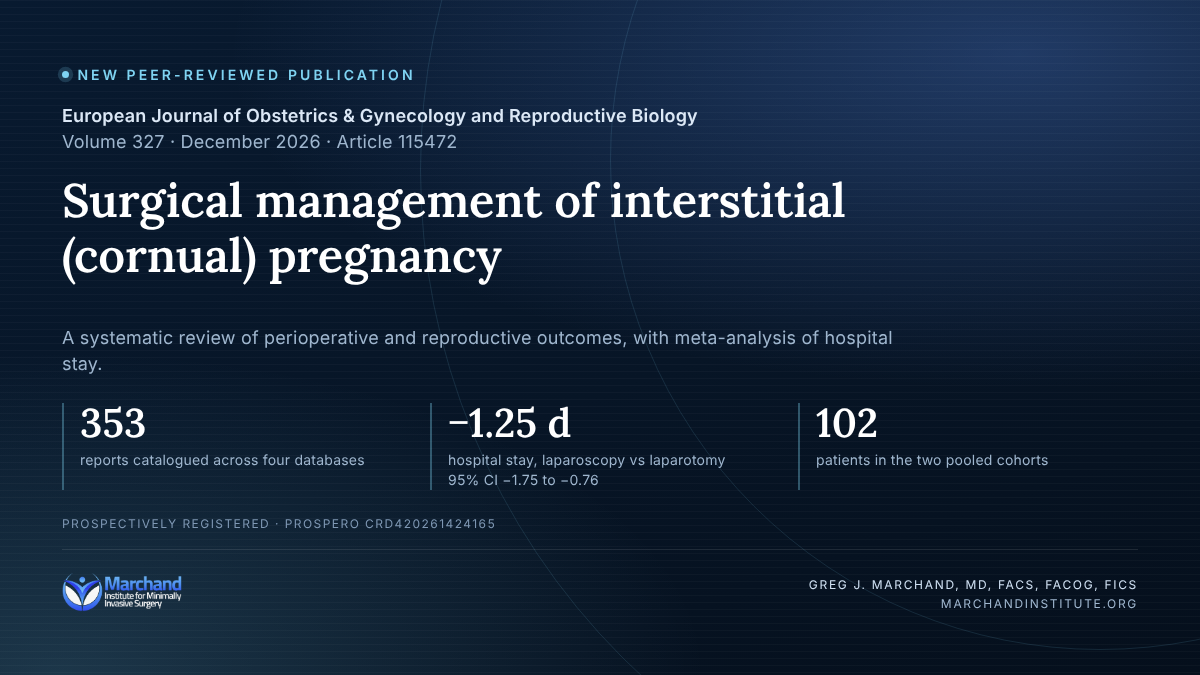
My team’s newest systematic review and meta-analysis is now online in the European Journal of Obstetrics & Gynecology and Reproductive Biology, Volume 327, December 2026, article 115472.
Surgical management of interstitial (cornual) pregnancy: a systematic review of perioperative and reproductive outcomes with meta-analysis of hospital stay
Marchand G, Anderson D, Mera S, O’Connell B, Robinson M, Palma A, Gonzalez Herrera D, Ibrahim F, Azadi A.
Read it free for 50 days
Elsevier has given me a share link that opens the final published article with no paywall, no registration and no fee, through November 28, 2026.
Read the full article free (through November 28, 2026)
After that date: journal page · PubMed, PMID 42854538 · DOI 10.1016/j.ejogrb.2026.115472
Why we did this review
Interstitial pregnancy, which many surgeons still call cornual pregnancy, implants in the part of the tube that runs through the uterine wall. It is uncommon, and it is dangerous, because the surrounding muscle lets the pregnancy grow longer before anything gives way. Over the last two decades management has moved from laparotomy to laparoscopic cornual resection and cornuostomy, and in most centers that shift is complete.
What has not moved at the same pace is the evidence. Nearly everything published on this condition is a case report or a small series. When a patient asks whether she can carry a pregnancy after cornual surgery, and whether her uterus will hold, there is very little in the literature that honestly answers her. That gap is what we set out to map.
How we did it
We searched PubMed/MEDLINE, Embase, Web of Science and CENTRAL through 5 July 2026, along with ClinicalTrials.gov and the reference lists of everything we retrieved. The protocol was registered prospectively with PROSPERO (CRD420261424165) and the review follows PRISMA. Screening and data extraction were done independently by two reviewers, with a third resolving disagreements. Screening identified 353 reports.
What we found
- Only two observational cohorts, 102 patients between them, reported hospital stay in a form that could be pooled. Laparoscopy was associated with a stay 1.25 days shorter than laparotomy (95% CI -1.75 to -0.76 days, I² 0%). Under a more conservative Knapp-Hartung model that interval widens to -4.47 to 1.96 days, which is a fair reminder of what two studies can and cannot carry.
- Transfusion could not be pooled, because one comparative cohort did not report counts specific to interstitial pregnancy. The data do not establish that the two routes are equivalent on the other perioperative outcomes.
- Fertility outcomes could not be pooled either. Populations, endpoints and denominators were simply not compatible across reports.
- Subsequent uterine ruptures are documented in the literature, but the number of treated cases is not a valid denominator for rupture risk. Nobody should be reassuring patients on the strength of the current evidence.
What it means
The direction of travel looks right. Laparoscopy is probably the shorter stay and it is already the default in most hands. The part that should bother us is how thin the reproductive data are for a condition whose patients are overwhelmingly young and want more children. Future reports need to say which treatment was given, who intended to conceive, what happened in the next pregnancy, and who was lost to follow-up. Without those four things we will still be writing this same review in ten years.
Congratulations and thanks to Dakota Anderson, Sarah Mera, Brooklynn O’Connell, McKenna Robinson, Adriana Palma, Daniela Gonzalez Herrera, Fatma Ibrahim and Dr. Ali Azadi for their work on this one.
Greg J. Marchand, MD, FACS, FACOG, FICS
Related posts


