

Now Online in the International Urogynecology Journal: Our Case Series of 252 Women With Midurethral Sling Complications
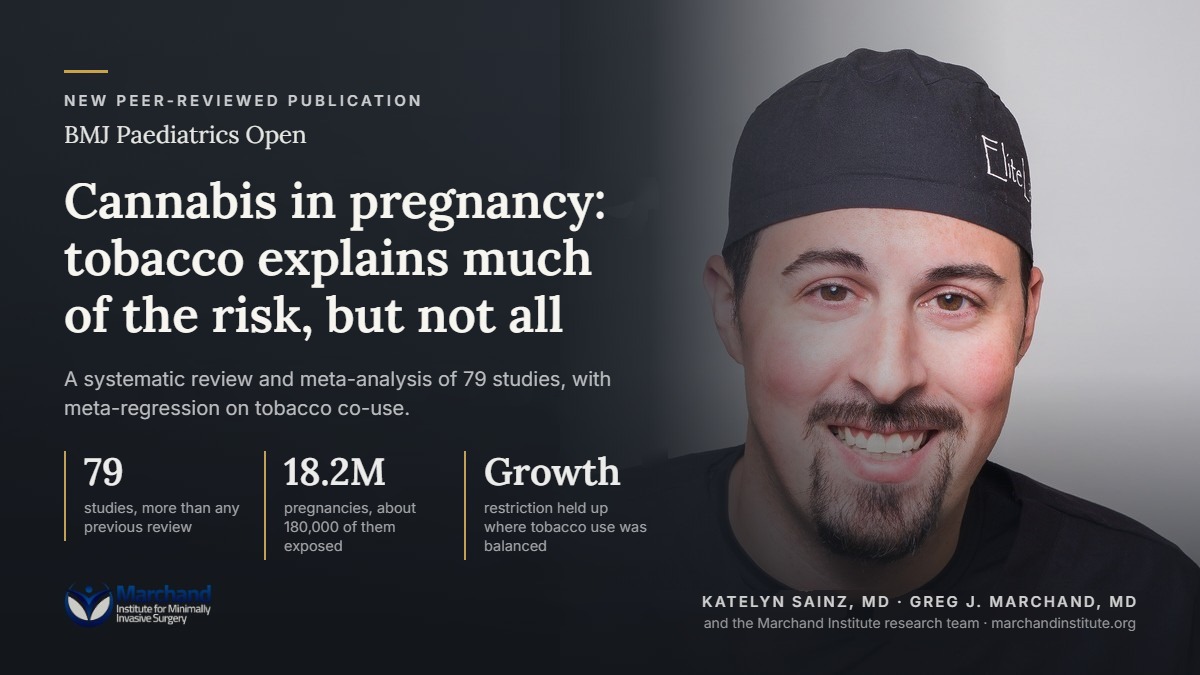
Our newest paper is online in BMJ Paediatrics Open, and it is open access, so anyone can read the whole thing. It goes back to a question my team first took on in 2022, this time with about five times the evidence and a much harder look at the one problem that has always dogged this literature: tobacco.
Prenatal cannabis exposure and adverse neonatal outcomes: a systematic review and meta-analysis with meta-regression on tobacco co-use
Sainz K, Gonzalez Herrera D, Robinson M, Kline E, Mera S, Koshaba M, O’Connell B, Ibrahim F, Marchand GJ. BMJ Paediatr Open. 2026;10(1):e004876. Published online November 13, 2026. DOI 10.1136/bmjpo-2026-004876.
Where to read it
The full article on bmjpaedsopen.bmj.com (open access, free to read) · DOI 10.1136/bmjpo-2026-004876. PubMed: PMID 43034090.
Why this paper matters to me
Our 2022 meta-analysis in JAMA Network Open pooled 16 studies of babies exposed to marijuana in utero, and it has become the most cited paper I have written. It also pooled crude numbers, with no adjustment for tobacco, and that is the first thing any careful reader asks about. Most women who use cannabis in pregnancy also smoke, and smoking on its own is one of the strongest causes of small babies and perinatal death. If we wanted to say anything useful about cannabis, we had to deal with tobacco head on.
Dr. Katelyn Sainz, a neonatology fellow at Dartmouth Hitchcock, led this one, and she sees these babies in the NICU. I am an OB-GYN surgeon who does a lot of epidemiology, which turns out to be a useful pairing for a question like this. The research team at the Institute did the heavy lifting on screening and extraction across nearly ten thousand records.

What we did
We searched eight databases through September 20, 2026, with no language restriction, and ended up with 79 studies that contribute data, covering about 18.2 million pregnancies and roughly 180,000 exposed to cannabis. That is more studies than any previous review of this question. Every record was screened by two people independently, with a third settling disagreements, and the review was registered with PROSPERO before we started (CRD420251065325).
The new part is how we handled tobacco. Earlier reviews regressed on how much the cannabis group smoked. That cannot detect confounding: if both groups smoke heavily, there is nothing to confound. What matters is the difference in smoking between the two groups, so that is what we regressed on, and we refused to pool any estimate that had already had tobacco adjusted out, because an estimate like that cannot test anything. We also pooled the studies whose groups smoked about equally on their own, and compared every study that reported both an adjusted and an unadjusted estimate.

What we found
- Cannabis exposure was associated with every outcome we looked at: small for gestational age (risk ratio 1.90), low birth weight (1.72), perinatal mortality (1.76), preterm birth (1.41), NICU admission (1.41) and a birth weight 166 g lower on average.
- The bigger the smoking gap between the groups, the bigger the association. Each 10-point widening raised the risk ratio by 11% to 16% for low birth weight, small for gestational age, preterm birth and NICU admission, and the gap explained a third to three fifths of the variation between studies.
- Where the groups smoked about equally, preterm birth and NICU admission were no longer significant. Small for gestational age (1.35) and low birth weight (1.38) were still raised, and both held up in the 39 studies that confirmed exposure with a lab test.
- Perinatal mortality showed no tobacco gradient at all, so tobacco does not explain it. Only three balanced studies reported it, though, which is too few to confirm.
- Within studies, adjustment that included tobacco removed a median of about half the association, anywhere from strengthening it to wiping it out. That is a big part of why we rate the certainty of this evidence very low, where the most recent review rated it moderate.
What it means
If you are pregnant: the advice is the same as it was. Avoid cannabis. If you also smoke, stopping both is the goal, and this paper is one more reason the two belong in the same conversation. If you counsel pregnant patients: bring up tobacco in the same breath, and lead with fetal growth, because that is the effect that survives the tobacco question. If you do meta-analysis in this field: pool estimates that have not already been adjusted for the confounder you are testing, use the difference between groups rather than prevalence in the exposed group, and report the tobacco-balanced studies on their own.

Thanks
Congratulations to Dr. Katelyn Sainz for leading this one, and thanks to Daniela Gonzalez Herrera, McKenna Robinson, Emily Kline, Sarah Mera, Michelle Koshaba, Brooklynn O’Connell and Fatma Ibrahim for the screening, extraction and assessment behind a review of this size.
Greg J. Marchand, MD, FACS, FACOG, FICS
Related posts


